I added it here because it gives a bit more understandable indepth information. Of course you can visit the website using this link. Maybe a warning is needed: This side has a 'military look'.
Home
Stepping inside PTSD
Indepth info
PDF in Ukranian
How your brain functions, how the various parts are supposed to work and what happens when causing PTSD
If
you're experiencing post-traumatic stress disorder, it might help to
have an idea of how your brain functions and how the various parts
are supposed to work. Sometimes just understanding what's going on in
your brain facilitates the process of recovery and can boost
understanding of the treatments used to help rewire your brain to get
back on track.
Post-traumatic stress is a normal response
to traumatic events. PTSD is a more serious condition that impacts
brain function and often results from traumas experienced during
combat, disasters, or violence.
Your brain is equipped with an alarm system that normally helps ensure your survival. With PTSD, this system becomes overly sensitive and gets triggered too easily. In turn, the parts of your brain responsible for thinking and memory stop functioning properly. When this happens, you have difficulty separating safe events happening now from dangerous events that happened in the past.
Background
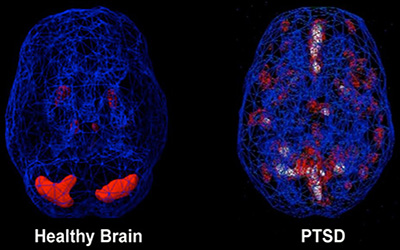
Over the past 40 years, scientific methods of "neuroimaging" have enabled scientists to see that PTSD causes distinct biological changes in the brain. Not everybody with PTSD has exactly the same symptoms or the same brain changes, but there are observable patterns that can be understood and treated.
The Brain's Alarm System
The diagram shows a cross section of the brain, and illustrates the parts discusses here.
The
amygdala of your
brain triggers your natural alarm system. When you experience a
disturbing event, it sends a signal that causes a fear response. An
extreme fear response makes sense when your alarm bells buzz at the
right time and for the right reason: to keep you safe.
Those
with PTSD tend to have an overactive response, so something as
harmless as a car backfiring could instantly trigger panic. The
amygdala is a primitive animalistic part of the brain, wired to
ensure survival; when it's overactive, it's hard to think rationally.
Your Brake System
Your brain's prefrontal cortex, the front-most part of the neocortex, helps you think through decisions, observe how you're thinking, and put on the brakes when you realize something you first feared is actually not a threat after all. The prefrontal cortex helps to regulate emotional responses triggered by the amygdala. In operators and enablers with PTSD, the prefrontal cortex doesn't always manage to do its job when it's needed.
What
happens in the brain what causes PTSD
Immediately
after you have received a ‘danger signal’ your body reacts by
releasing lots of adrenaline to get you active to survive. Now you
can fight or run but sometimes the adrenaline shot is so high that it
shuts down the system, the energy comes to an abrupt halt, with a
shock, you become immobile, you freeze. If this state of immobility
takes too long, if you are not able to release the energy by fighting
or running or any other active action, it will block, or block
partially, the pass way to the prefrontal cortex (thinking,
reasoning brain). From then on you are stuck in the moment of
the terrible experience because your thinking brain can't tell you
the ordeal is over but it will try to tell you over and over again
but there is no context between your emotions and the few images
which managed to reach the prefrontal cortex, the story is not
complete. This causes the nightmares and flashbacks, the brain is
trying to restart, it tries to heal itself to normal. The very high
energy level stays in your nerve system which will be
constantly alert and warning you constantly for danger although you
are save at that moment, for your brain everything is dangerous, even
at people you have trust all your live you will look at suspiciously,
you will feel unsafe constantly and you will react aggressive just to
survive although you are safe, there will be triggers everywhere
which will throw you back to the moment of the shocking event. The
balance in your brain is gone until this disturbance is fixed and the
pass way to your prefrontal cortex is open again, balance restored,
you have to win control again. If you haven't been able to win
control after a month, it is wise to ask for help because from there
things will only get worse. There are ways to regain control with
help from specialized people. This is not weakness, this is wisdom.
Don't let an traumatic experience rule the rest of your life and the
lives of the people you love and who loves you.
A Bad Combination
An overactive amygdala combined with an underactive prefrontal cortex creates a perfect storm. It's like stomping on the accelerator of your car, even when you don't need to, only to discover the brakes don't work. This might help you understand why someone with PTSD might: feel anxious around anything even slightly related to the original trauma that led to the PTSD; or have strong physical reactions to situations that shouldn't provoke a fear reaction; and avoid situations that might trigger those intense emotions and reactions.
System Recall Errors
Other common PTSD experiences—such as unwanted feelings that pop up out of nowhere or always being on the lookout for threats that could lead to more trauma—seem to be related to the hippocampus, or memory center of your brain. When your hippocampus doesn't work right, you can't recall important memories when you need them, or fearful ones turn up at the wrong times, confusing your sense of "right now". You can't match up the fact that you're safe (or not) with the right memories.
Overcoming PTSD
Treatment
techniques for PTSD
include cognitive
restructuring,
stress inoculation training, and exposure therapy. With cognitive
restructuring,
you learn new ways to think about things—reframing your thoughts—to
match current conditions. It also helps you become aware of
cognitive errors in your thinking and learn strategies to correct
them. It helps you experience different feelings and different
reactions. For instance, you might replace "I can't handle this
anxiety," with "I don't like these feelings, but I can
handle them, and they'll pass."
Stress
inoculation
teaches you to anticipate stressful events and know that you can
handle them with minimal discomfort. You learn to habitually pair
things that trigger fear with relaxation techniques and coping
strategies, which enables you to manage your anxiety when stress
comes along.
Exposure
therapy
exposes you to alarming stimuli in a safe way, pushing your body and
mind into recognizing when you're safe. It's like watching a scary
movie repeatedly until it doesn't scare you anymore. It helps your
alarm system avoid misfiring. It also helps you access relevant
memories so you know if you're safe. And it helps you access your
mental brakes so that, when your alarm does ring, you can apply the
brakes if you need to.
What can you do yourself? Playing games
for which logical thinking is necessary, start easy with memory games, puzzles,
Tetris, first games for children and then the more complex ones, Tetris can be
an excellent help (also free online). Don’t get alarmed when it turns out to be
difficult, keep on trying and try to have fun, relax! Playing these games with
other people and having fun in the first place is a very good start, they can
be a start to open the (partially) blocked road to your prefrontal cortex, the
road to logical thinking.
Debrief
Your
amygdala, prefrontal cortex, and hippocampus all contribute to the
emotions and actions associated with fear, clear thinking,
decision-making, and memory. Understanding these parts of your brain
and how they work also might help you understand why some therapies
can help you work through PTSD.
https://www.socom.mil/POTFF/Pages/PTSD%20affects%20brain%20circuitry.aspx
Sorag Akademie: Traumacoaching